
Calculator
Enterprise value to equity value calculator
Work from the value of the operating business to the value of the shares, one transparent line at a time. Every definition and formula is on this page.
- Written for
- Accountants, transaction advisers, finance educators and owners checking a proposal.
- Answers
- How do cash, debt and other adjustments turn an enterprise value into the value of the shares?
Illustrative arithmetic, not a valuation. This tool shows how the numbers you enter combine. It does not test whether those numbers are right, and it is not an independent valuation of any business. Everything runs in your browser: nothing you type is sent to Valuo or recorded in analytics.
Definitions and assumptions
| Item | What it means here | Common mistake |
|---|---|---|
| Enterprise value | Value of the operations, assuming the business is delivered with a normal level of working capital and without its cash or debt. | Starting from a figure that already deducted debt, then deducting it again. |
| Surplus cash | Cash beyond what the business needs for payroll, suppliers and seasonal swings. | Adding the full bank balance, including cash the business needs to trade. |
| Interest-bearing debt | Borrowings that carry interest and must be repaid. | Forgetting equipment finance or a drawn overdraft. |
| Debt-like items | Obligations that will cost the owner cash and are not already in working capital. | Deducting an item that is also inside working capital (double counting), or missing overdue tax. |
| Working capital adjustment | The gap between the working capital actually delivered and the normal level assumed in enterprise value. | Treating cash as both surplus and working capital. |
| Leases | The tool has no separate lease line. Whether lease liabilities are debt depends on whether the earnings used for enterprise value were before or after rent; treat them consistently. | Deducting lease liabilities from a value built on earnings that already bear the rent. |
Worked example
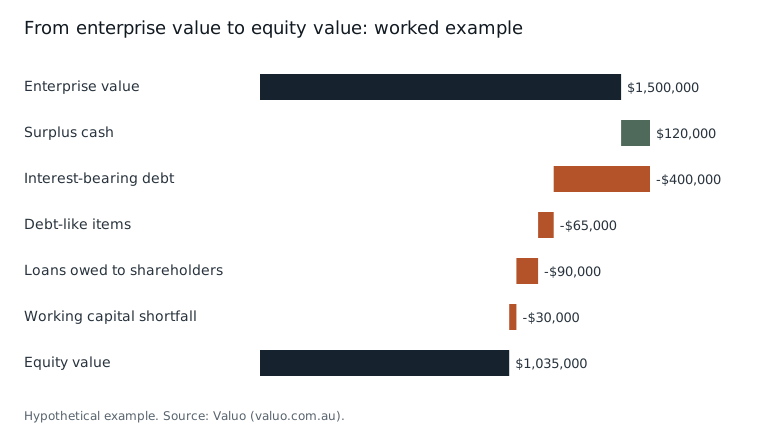
A hypothetical company has an enterprise value of $1,500,000. It holds $120,000 of surplus cash, owes $400,000 to its bank, has $65,000 of debt-like items (overdue tax and unfunded leave), and owes $90,000 to a shareholder. Its working capital at the valuation date is $180,000, against a normal level of $210,000.
| Enterprise value | $1,500,000 |
|---|---|
| Surplus cash | $120,000 |
| Interest-bearing debt | −$400,000 |
| Debt-like items | −$65,000 |
| Loans owed to shareholders | −$90,000 |
| Working capital shortfall | −$30,000 |
| Equity value | $1,035,000 |
A 30% holding has a pro-rata share of $310,500. That is arithmetic, not the market value of the holding: the rights attached to the shares, any shareholders agreement or valuation clause, control and the purpose of the valuation can all move the answer up or down.
When this calculation is unsuitable
- Negative results. If debts exceed the enterprise value plus other assets, the shares are not worth a negative amount to a limited-liability holder; the question becomes solvency, guarantees and what the assets would realise.
- No reliable enterprise value. The bridge is only as good as its starting point. A loss-making or start-up business may need a different method altogether.
- A transaction with its own definitions. Sale agreements define cash, debt and working capital in their own terms. Follow the agreement.
- Minority and control questions. See whether a holding is worth its percentage.
Cite or reuse this page
Valuo Insights team (2026). Enterprise value to equity value calculator. Valuo. https://valuo.com.au/insights/tools/enterprise-to-equity-value-calculator/ (updated 14 November 2026).
Quote short passages with attribution and a link to this page. Charts and tables created by Valuo may be republished unchanged with the credit "Source: Valuo (valuo.com.au)" and a link. Third-party sources keep their own terms. See the reuse terms.